
Written by
RTO means Regional Transport Office. Check which RTO a vehicle number belongs to, find every state’s RTO code, and see the RTO forms, fees and services you need.
Written by
Find the RTO that registered your vehicle in India
Every state and territory
RTO code and office name
Free, no login needed
RTO stands for Regional Transport Office. It is the state government office that registers vehicles, issues driving licences, collects road tax and enforces the Motor Vehicles Act, 1988 in its area.
Every vehicle on an Indian road is linked to one RTO. The office that registers your car gives it the code you see at the start of the number plate, and it keeps the car’s record for as long as the car stays in that area.
RTO has two meanings. It is short for Regional Transport Office, which is the office itself, and also for the Regional Transport Officer, the person who heads it. Many people search for it as “Road Transport Office”, but Regional Transport Office is the official name.
States use different names for the same kind of office. You may see these on your documents or on the state transport website.
Words you will read on this page, explained in plain language

The official record that your vehicle is registered, with the owner, the vehicle details and the registration number

The number on your number plate, made up of the state code, the RTO code, the series letters and a four-digit number

A short-term number that lets a new vehicle be driven legally until permanent registration is complete

A letter from an RTO or a lender saying it has no objection to a transfer, a move or a loan being closed

A note on your Registration Certificate that the vehicle is on a loan, until the lender is repaid

A tax paid to the state when a vehicle is registered, usually once for 15 years for private cars

Known as HSRP, a tamper-proof aluminium number plate with a hologram and a laser code, required on every vehicle

A national registration number for eligible owners with transferable jobs, valid in every state

The government portal for vehicle services such as registration, ownership transfer and road tax

The government portal for driving licence services, from learner’s licence to renewal
The umbrella government portal linking Vahan, Sarathi and other transport services from the Ministry of Road Transport and Highways (MoRTH)

Known as a PUC certificate, it shows your vehicle’s exhaust is within legal limits and is needed for many RTO services

A vehicle used to carry paying passengers or goods, such as a taxi or truck, with its own plate colour
An RTO keeps the record of every vehicle and driver in its area. It registers vehicles, issues driving licences, collects road tax, transfers ownership and checks that vehicles are fit to be on the road.
Most people visit an RTO only a few times: When they buy a vehicle, get a driving licence, sell a vehicle or move to another city. These are the RTO services you are most likely to need.
Registers new vehicles, issues the Registration Certificate (RC), and renews registration for older private vehicles
Runs the learner’s licence and driving tests, and issues and renews driving licences for every vehicle class
Collects road tax for the state and the fees for registration, transfer and duplicate documents

Moves the RC into the new owner’s name when a vehicle is sold, gifted or passed on after a death
Issues a No Objection Certificate (NOC) when you take your vehicle to another state or close a loan

Issues fitness certificates and permits for transport vehicles, and checks vehicles for safety and pollution
RTOs are run by state governments, not by the central government. Each state sets up its transport offices under Section 213 of the Motor Vehicles Act, 1988, and the Parivahan Sewa portal lists more than 1,400 of them.
The central government writes the national rules and runs the online portals. The state decides how many offices it needs, where they are and which areas each one looks after. That is why RTO names and codes look different from state to state.
The Ministry of Road Transport and Highways (MoRTH) makes the national rules and runs the Parivahan, Vahan and Sarathi portals
Headed by the Transport Commissioner, it runs every RTO in the state and sets the state’s road tax
The main office for a region or a large city, headed by the Regional Transport Officer
A District Transport Office (DTO) or Assistant Regional Transport Office (ARTO) handles the same work for a smaller area
A separate body that grants permits to taxis, buses and goods vehicles in the region
An RTO code is the first four characters of a number plate. The two letters are the state code, and the two digits are the RTO that registered the vehicle. MH 12, for example, is a car registered at the Pune RTO in Maharashtra.
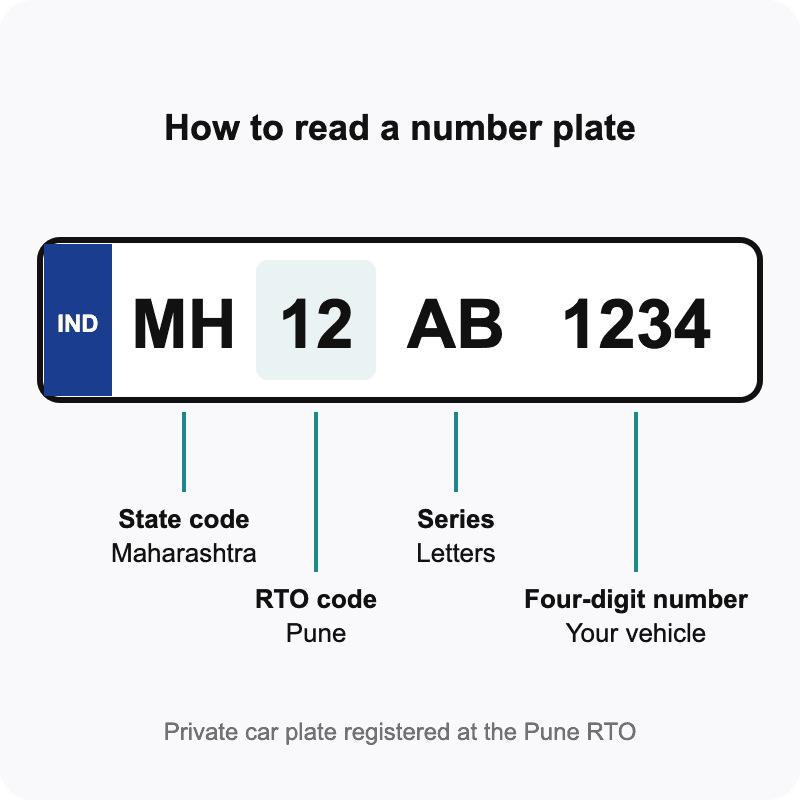
The RTO code is also called the RTO number or passing code. It does not change when the owner moves to a new address in the same state. The code changes only in two cases: The vehicle is registered again in another state, or its registration details are changed.
Most plates follow the pattern above. These are the exceptions that confuse people most often.
Reads like 26 BH 1234 AB and is valid in every state. Open to government, defence and public sector staff, and some private staff
The code changed from TS to TG in 2024. New vehicles get TG, older TS plates stay valid, and TS 09 and TG 09 are the same RTO
Since 2019, new vehicles in every district get AP 39, with AP 40 added in 2023. Older cars keep codes such as AP 16
13 zonal RTOs, DL 1 to DL 13, plus a letter for the vehicle type. DL 3C is a car registered at the Sheikh Sarai RTO
Under the One RTO One Code change, each RTO now issues one series. Salt Lake RTO, for example, issues WB 07V
A new vehicle waiting for permanent registration carries red letters on a yellow plate, valid for up to one month
The colour of a number plate shows how a vehicle is registered. White plates are for private vehicles, yellow plates are for commercial vehicles, and green plates are for electric vehicles.
| Number plate | Used for |
|---|---|
 Black letters on white | Private cars, bikes and scooters |
 Black letters on yellow | Commercial vehicles such as taxis, buses and trucks |
 White letters on green | Private electric vehicles (EVs) |
 Yellow letters on green | Commercial electric vehicles, such as electric taxis |
 Yellow letters on black | Self-drive rental vehicles |
 Red letters on yellow | New vehicles on a temporary registration |
 White letters on red | Vehicles held by dealers under a trade certificate |
 White letters on blue | Vehicles of foreign embassies and diplomats |
The President’s and Governors’ official cars carry a red plate with the national emblem instead of a number. Armed forces vehicles are registered by the Ministry of Defence, not by an RTO.
Every plate must be a High Security Registration Plate (HSRP). The HSRP section below explains what the plate carries and how to get one fitted on an older vehicle.
What a High Security Registration Plate must carry, and how to get one on an older vehicle
A High Security Registration Plate (HSRP) is a tamper-proof number plate that every vehicle in India must carry. The requirement comes from Rule 50 of the Central Motor Vehicles Rules, 1989, and MoRTH notified it in two orders: G.S.R. 1162(E) dated 4 December 2018 and S.O. 6052 dated 6 December 2018.
A chromium-based hologram is printed on the plate, which makes a fake plate easy to spot
Each plate has its own identification number, etched by laser, so no two plates are the same
The plate is held on by snap locks. These are non-removable, and a broken lock cannot be used a second time
A third registration mark is stuck on the windscreen. It is light blue for petrol and compressed natural gas (CNG) vehicles, and orange for diesel vehicles
Since 1 April 2019, the maker and the dealer have fitted an HSRP on every new vehicle. If your vehicle was registered before that date, you need to get an HSRP fitted by the deadline your state gives.
Worth knowing: Each state names its own HSRP booking portal on its transport department website. Book the HSRP installation through that portal, and check there the date that applies to your vehicle.
Every state and union territory, its code, an example RTO and a link to the full list of RTO codes
India has 36 state and union territory codes, from AN for the Andaman and Nicobar Islands to WB for West Bengal. Each state then numbers its own RTOs, so the full code list runs into more than a thousand codes.
Some states reuse old codes or leave gaps when districts are split. Each state guide lists every RTO code in that state with its office.
The RTO you need is the one whose area includes the address on your Registration Certificate. Big cities have several RTO offices, each looking after its own zone, so the nearest RTO office is not always the one you need.
Open your state guide below to see every RTO in that state, with its code, its city and the areas it covers. Each guide also links to the city and office pages for that state.
Mumbai, Pune, Nashik
Noida, Lucknow, Ghaziabad
Ahmedabad, Surat, Vadodara
Bengaluru, Mysuru, Mangaluru
DL 1 to DL 13
Hyderabad, Warangal
Chennai, Coimbatore, Madurai
Gurugram, Faridabad
Bhopal, Indore, Gwalior
Jaipur, Jodhpur, Kota
IRDAI licensed insurer
Cashless partner garages
Dedicated Claims Specialist
Big cities have several RTO offices, each looking after its own zone. Open your city guide to see every RTO office in the city, its code and the areas it covers.
DL-1 to DL-13
MH-01 to MH-03, MH-47
KA-01 to KA-05 and more
TG-09 to TG-13 and more
TN-01 to TN-14, TN-22
WB-01 to WB-10 and more
MH-12
GJ-01, GJ-27, GJ-38
UP-16
UP-14
Every vehicle must be registered with an RTO before it can be driven on a public road. A new vehicle gets a temporary registration first, which is valid for up to one month, and then a permanent registration and Registration Certificate.
In most states the dealer handles registration for you on the Vahan portal. You pay the road tax and registration fee with the vehicle’s price, and the RC reaches you once the RTO approves it.
The RTO verifies the documents and inspects the vehicle itself if its rules require it.
A private car’s RC is valid for 15 years from the date of registration. After that, the owner can renew it for 5 years at a time, once the RTO confirms the car is still fit to be on the road. A transport vehicle needs a fitness certificate renewed at shorter intervals instead.
Important to know: You do not have to take the policy the dealer offers. Any valid policy lets the dealer register the car, so compare prices before the delivery date.
How the RC moves to the new owner after a sale, and how to remove a loan from it
When a used car is sold, the RTO that holds its registration moves the RC into the buyer’s name. You can apply on the Vahan portal or at that RTO, and the transfer fee is ₹300 for a car and ₹150 for a motorcycle.
The seller informs the RTO of the sale with Form 29, and the buyer signs it too
Both sign Form 30, which asks the RTO to show the buyer as the new owner on the RC
Hand in the forms with the RC, the insurance policy, a Pollution Under Control (PUC) certificate and address proof
Pay ₹300 for a car or ₹150 for a motorcycle on Vahan or at the RTO counter
From the date of transfer, the buyer has 14 days to move the insurance into their name
After you pay the last instalment of a car loan, ask the lender for a No Objection Certificate (NOC) and a signed Form 35. Apply on the Vahan portal to remove the hypothecation, and the RTO issues an updated RC without the lender’s name.
Good to know: Form 34 works the other way round. It adds the lender’s name to the RC when a car is bought on a loan.
What changes when a car has no state code A Bharat series (BH) number plate is a pan-India registration mark for private vehicles, introduced by the Ministry of Road Transport and Highways in 2021. A BH vehicle carries no state code, so the owner does not need a No Objection Certificate (NOC) or a new registration mark when they move to another state.
Employees of the central or a state government, defence personnel, employees of public sector undertakings, and employees of private companies with offices in four or more states or union territories
The format is YY BH #### XX, where YY is the year of first registration, the four digits are allotted at random, and XX represents the alphabetic series, which can be a single letter or two letters. It is black on a white plate, like any other private car
Tax is 8% of the invoice price below ₹10 lakhs, 10% up to ₹20 lakhs and 12% above that, with 2% more for a diesel car and 2% less for an electric car, paid in 2-year blocks
The vehicle is registered through the RTO that covers the address on the application. After that, you deal with the RTO where you live, since there is no state code tying the vehicle to one state
No No Objection Certificate, no re-registration and no road tax refund claim. You pay the next 2-year block of tax as usual
A car already registered with a state code can be moved to the BH series, and a BH vehicle can be sold to someone who is not eligible, under the 2022 amendment
A BH plate is worth having if you are posted between states. If you expect to stay in one state, a normal state registration is simpler, since the road tax is paid once and there is nothing to renew every 2 years.
Eligibility, tax and applying
Most RTO services now start online on the Parivahan Sewa website. Vehicle services run on the Vahan portal and driving licence services run on the Sarathi portal. Since 2022, 58 services can be completed fully online with Aadhaar authentication, without visiting the RTO.
Visiting the RTO in person still works, and some owners prefer it for a first transfer or a state move. Either way, you apply online first and book a slot if a visit is needed.
Open the Parivahan Sewa website or the mParivahan app and choose the option to view vehicle details. Enter the registration number and verify with the one-time password sent to your mobile. You will see the RTO, the registration date, the fuel type and whether insurance and a Pollution Under Control (PUC) certificate are valid. The owner’s name is partly hidden for privacy.
If your RC is lost, stolen or damaged, apply for a duplicate on the Vahan portal with Form 26. The fee is ₹300 for a car and ₹150 for a motorcycle. To see where your application stands, check the RC status on the Parivahan Sewa website or in the mParivahan app, or check your RC status with Kiwi Insurance.
The Sarathi portal handles driving licence work in every state. Use it to apply for a learner’s licence, book a driving test, renew your driving licence or get an International Driving Permit. Form 2 and Form 4A in the forms section are the paper versions.
Common fines under the Motor Vehicles Act, and how to check and pay a challan
Traffic fines in India are fixed by the Motor Vehicles (Amendment) Act, 2019. Driving without insurance costs ₹2,000 for a first offence and ₹4,000 for any offence after that. The table below lists the other common fines.
States can compound some offences at their own amounts, so the amount shown on your challan is the one you pay. To check for a challan, enter your vehicle number on the Parivahan e-challan portal, echallan.parivahan.gov.in, or in the mParivahan app, and pay it online.
Keep in mind: Of all these fines, the one for driving uninsured is the easiest to avoid. Keep your car insurance valid and renew it before the expiry date.
The forms used in every state, with a plain note on each and the official PDF


For a used car sale, the seller and the buyer use Form 29 and Form 30, as the ownership transfer steps explain. Once the RC shows the buyer’s name, move the insurance within 14 days.
Worth knowing: Submit forms to the RTO whose code is on your RC. Private sector employees applying for a Bharat series number also submit Form 60, a certificate from their employer. Some RTOs ask for address proof or a Pollution Under Control (PUC) certificate as well, so look at the document list on the Parivahan Sewa website before you apply. The full set of forms is on the Parivahan Sewa forms page.
RTO fees are set by Rule 81 of the Central Motor Vehicles Rules, 1989. Registering a new private car costs ₹600 and a motorcycle costs ₹300. Road tax is separate, and each state sets its own.
States can charge less than these amounts and may add service charges. Battery-operated vehicles do not pay the fee to issue or renew an RC or to get a new registration mark.
RTO office timings are set by each state. Most RTO offices work on weekdays during government office hours, and some open on selected Saturdays. Book a slot on the Parivahan Sewa website so you are not kept waiting.
Choose your service on Vahan or Sarathi, pay the fee and pick a date and time before you go
Take your RC, driving licence, insurance policy document and a valid PUC certificate
One copy of each document, along with the printed application and the fee receipt
Aadhaar or another accepted proof in the name on the application
Needed for fitness checks, some state moves and some ownership transfers
The RTO that registers your car affects its insurance premium. The city of that RTO decides the zone for the Own Damage part of the premium, while the Third-Party premium is the same everywhere in India. Third-Party insurance is also required by law to register and drive a car, and every change you make at the RTO should also be made on your policy.
The insurer checks your RC details when you raise a claim. A policy in an old owner’s name, or an address that no longer matches, can slow the claim down. These are the moments when RTO work and car insurance meet.
The dealer needs a valid car insurance policy before registration. Take comprehensive cover so the new car itself is protected

Third-Party cover moves to the buyer automatically. The buyer applies within 14 days to transfer the whole policy

When you sell, your No Claim Bonus (NCB) stays with you, not the car. Ask the insurer for a letter that confirms it

Update the RC with your new address, then make the same change on the policy. The premium may differ in the new city
The lender’s name goes on the RC and the policy. Remove it from both once the loan is repaid

A digital RC and policy in DigiLocker or the mParivahan app are accepted by traffic police
After a sale, Own Damage cover does not move on its own. Until the policy is transferred, the buyer is covered only for damage to other people and their property, not for damage to the car they just bought.
Worth knowing: Try to complete the RC transfer and the policy transfer within the same 14 days. The car then has full cover from the day the new owner takes it.
Every vehicle in India needs Third-Party insurance to be registered and driven, and the RTO looks at the policy with your other documents With the RTO paperwork complete, check that the policy is in your own name. Kiwi Insurance covers both cars and bikes, and the links below show the plans for each.
Explore plans
Explore plans
Employees of the central or a state government, defence personnel, employees of public sector undertakings, and employees of private companies with offices in four or more states or union territories.
Car insurance built around the day you need to make a claim, with benefits you only get with Kiwi Insurance

Once you register a claim, one specialist dedicated to your claim works with the surveyor and garage and keeps you updated
Builds your No Claim Bonus (NCB) up to a 90% discount and goes down only one slab after a claim, not to zero
Repair your car at a cashless partner garage and the insurer pays the garage directly, so you pay nothing out of your pocket

An optional cover for your usual garage. The claim settlement amount reaches your account before you pay the garage

An optional cover that lets you keep a minor dent on record and repair it together with a bigger claim later

An optional cover that pays cash into your account the day your car is booked in for repair
Kiwi Insurance Super NCB
Kiwi Flexi Repair
Kiwi InstaCash


Written by
Content Writer
Afsal writes Kiwi’s guides and blog posts and reviews each one for accuracy, clarity and compliance with current rules before publication.
As a policyholder, you can recharge FASTag, pay traffic fines, and check your car’s PUC expiry
QR
App Store
Google Play
IRDAI licensed insurer
Cashless partner garages
Dedicated Claims Specialist