Written by
One union territory, two code letters and three districts. Find which office covers Silvassa, Daman or Diu, what the 2020 merger changed, and the road tax on a new car.
Written by
Enter a registration number or RTO code
DN and DD codes
All offices and districts
Free, no login needed
Dadra and Nagar Haveli and Daman and Diu RTOs are run by the union territory’s Transport Department, with one Regional Transport Office (RTO) in each of its three districts. The districts are not next to each other, and the territory still uses two sets of code letters.
A number plate here starts with DN or DD, as the two former union territories kept their own letters. It has four parts: In DD 01 AB 1234, the letters DD mean Daman and Diu, 01 shows the Daman office, AB is the series of letters and 1234 is the four-digit number. A Silvassa car shows DN 09 instead of DD 01.
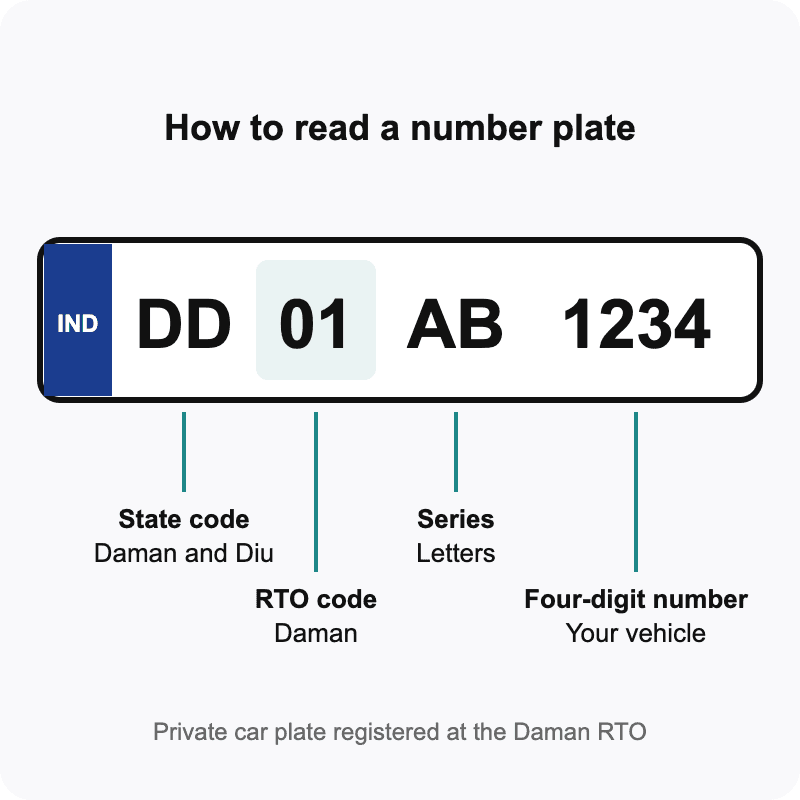
As the code records the office that first registered the vehicle, it says nothing about where the owner lives now. A DN or DD code stays the same if the owner moves to another district of the union territory. It changes only when the vehicle is registered again outside the territory or its registration details are changed.
Worth knowing: DN and DD plates both belong to the same union territory now. The letters tell you which district registered the vehicle, not that it came from somewhere else.
Why the plate is built the way it is, and what older DN and DD vehicles need
To stop a plate being taken off and reused on another vehicle, every car and bike here must carry a High Security Registration Plate (HSRP). It is a national requirement under Rule 50 of the Central Motor Vehicles Rules, 1989.
Two MoRTH notifications brought it in: G.S.R. 1162(E), issued on 4 December 2018, and S.O. 6052, issued on 6 December 2018. MoRTH is the Ministry of Road Transport and Highways.
Each plate carries a chromium-based hologram, a mark that the plate is genuine
So that each plate can be traced, a unique identification number is laser-etched onto it
To keep the plate on the vehicle it was made for, it is fixed with snap locks that cannot be removed or reused
A colour-coded sticker on the windscreen shows the fuel: Light blue for petrol and compressed natural gas (CNG), orange for diesel
Since 1 April 2019, the manufacturer and dealer have fitted the plate on new vehicles, so only vehicles registered before that date still need one fitted, by the dates the administration sets. You can book the installation on the HSRP booking portal listed on the website of the Transport Department, Administration of Dadra and Nagar Haveli and Daman and Diu, and see there which date covers your DN or DD vehicle.
The codes in use across the three districts
The code list here is short, since the union territory has three districts and one office each. The letters on the plate show which district registered the vehicle.
Published lists disagree about whether a second Daman series is in use, so it is shown as pending. Confirm your own office with the Transport Department of the union territory before you visit.
The union territory is spread across three separate pieces of land, so each district runs its own office and you deal with the one that covers your address.
The capital, inland between Gujarat and Maharashtra, covering the Dadra and Nagar Haveli district
On the Gujarat coast north of Silvassa, covering the Daman district
An island off the Saurashtra coast, several hundred kilometres west of the other two districts
All three report to the same Transport Department, so the rules, forms and fees are the same across the territory
GJ codes and offices
MH codes and offices
Every state and territory
And what it did not change for vehicle owners
Dadra and Nagar Haveli and Daman and Diu were two separate union territories until 26 January 2020, when they became one. For vehicle owners, very little changed on the ground.
Vehicles already registered kept their DN or DD numbers, and both series remain in use. A plate is only replaced if the vehicle is registered again somewhere else.
Silvassa, Daman and Diu each kept their registering office, since the three districts are far apart and a single office would not be practical.
Worth knowing: Insurers treat DN and DD registrations the same way. The premium follows the car and the registered address, not which series the plate carries.
All three districts are surrounded by Gujarat or Maharashtra, so most vehicles on the road here carry GJ or MH plates. As those are the plates you meet most, the guides below explain how their codes and offices work.
GJ codes and offices
MH codes and offices
Every state and territory
IRDAI licensed insurer
Cashless partner garages
Dedicated Claims Specialist
Road tax in this union territory is charged once, as a flat share of the cost that depends on the fuel rather than on a price band. The rates below are those of Schedule B of the Daman and Diu Motor Vehicles Tax (Amendment) Regulation, 2010. The merged union territory may have revised them since, so treat the amount on Vahan as the one that applies.
For example: At 4%, a ₹6 lakhs petrol car registered in Silvassa pays ₹24,000 once. A diesel car at the same price pays 6%, which comes to ₹36,000.
These rates apply to vehicles registered here, and registration follows the address on your paperwork rather than where you buy the car
The tax here falls due when a car from another state is re-registered, which the law requires after 12 months in the territory
A diesel car pays 6% under the 2010 regulation, 2 percentage points more than a petrol or CNG car, whatever its price
A vehicle brought in from abroad pays twice the normal rate for its fuel or type
A taxi, bus or goods carrier pays on a different schedule here, based on its seats or the weight it carries
Since the administration can revise its rates, look at the amount Vahan shows before paying. You can pay it yourself through the vehicle tax service on Parivahan Sewa, or let the dealer include it in the on-road price.
Service fees at the Silvassa, Daman and Diu offices, apart from road tax
As the fees come from Rule 81 of the Central Motor Vehicles Rules, 1989, Silvassa, Daman and Diu all charge the same base amounts. They are paid on Vahan or at the office counter whenever a Registration Certificate (RC) is issued, renewed or changed.
Not included: The HSRP, the road tax and any service charge the administration adds are separate, as they are not part of the Rule 81 schedule. Vahan lists each amount before you pay.
As the application is made on Vahan and the dealer already holds your papers, dealers in Silvassa, Daman and Diu usually file it for a new private car. The road tax and registration fee are added to what you pay for the car, and the Registration Certificate (RC) follows after the RTO has approved it.
As an RTO will not register an uninsured car, buy a Third-Party policy now. Many owners pick comprehensive cover
With Form 20, the dealer sends your address proof plus the sale and roadworthiness certificates
Clear the road tax and the registration fee that Vahan works out for your car
On approval the office issues a DN or DD number, and a High Security Registration Plate goes on the car
The RC comes from the office that approved the application, sent to the address you gave
Some cases still need a document check, an inspection or a visit to the RTO, as the process depends on the vehicle and the transaction. So take these five steps as what usually happens, not as a promise for every car.
Important to know: Since the dealer needs nothing more than proof of a valid policy, you are free to buy the car insurance yourself before delivery and compare plans first.
Putting a used car in the buyer’s name, and clearing a loan from the RC
Since the RC is held by the office that issued it, a used car sale is recorded at that office or on Vahan. A DD-01 car sold in Silvassa is still transferred by the Daman office.
Form 29 tells the office on the RC that the car has been sold
Since the RC must show the new owner, Form 30 asks the RTO to enter the buyer’s name
Attach the RC, the current policy, a Pollution Under Control (PUC) certificate and the buyer’s address proof
A car costs ₹300 to transfer, paid on Vahan or at the office counter
Within 14 days of the sale, the buyer applies to move the insurance into their name
Since the lender’s name stays on the RC until the loan is cleared, collect the lender’s No Objection Certificate (NOC) and Form 35 after the last instalment. Apply on Vahan, and the RTO issues an updated RC without the loan.
Good to know: Loans go on the RC through Form 34, the reverse of Form 35, when a car is financed.
As the union territory runs on the national Parivahan services, the same portals work in all three districts. The Vahan portal covers registration, the RC, tax and ownership. The Sarathi portal covers driving licences, and mParivahan with the e-challan service shows vehicle details and challans.
Not every task can be finished online, and that differs from one office and service to the next.
Start the application on Sarathi, pay online, then choose a date for the learner’s test
Pick a slot for the test, which some centres run on an automated track
Road tax and RTO dues on a DN or DD vehicle are paid through Vahan
Any e-challan on a DN or DD number can be seen and settled on the Parivahan Sewa e-challan portal
Enter a number on Parivahan Sewa or in mParivahan to see its office, insurance and Pollution Under Control (PUC) status
If the RC is lost, stolen or damaged, the remedy is a duplicate: Apply with Form 26 on Vahan and pay the fee listed in the fees table above. For the current state of a DN or DD registration, Parivahan Sewa and mParivahan both show the RC status, and you can also check your RC status on Kiwi Insurance.
Licence work runs through Sarathi here, as it does across India: The learner’s licence, the driving test, licence renewal and the International Driving Permit. Form 2 and Form 4A in the forms section below are the paper copies.
National fine amounts, and where to check a challan on a DN or DD vehicle
As traffic fines come from a national law, a challan here starts from the same amounts as anywhere in India. The Motor Vehicles (Amendment) Act, 2019 fixes those below, and the administration can compound some offences at its own amounts, so the challan itself shows what is due.
Since e-challans are issued against the registration number, entering a DN or DD number on echallan.parivahan.gov.in or in mParivahan shows any that are pending, and both let you pay.
Worth knowing: Of the fines above, only the one for driving uninsured can be avoided simply by holding a valid policy for the car.
The Motor Vehicles Act, 1988 ties a car’s registration to where it is kept, so a car that stays in the union territory beyond 12 months needs a DN or DD number. Registering it here means paying the tax due here, and you can then ask your old state to refund any unused tax.
Your old RTO issues the No Objection Certificate (NOC) on Form 28, so apply there first
Take the NOC to Silvassa, Daman or Diu with the RC, the policy and a Pollution Under Control (PUC) certificate
The territory’s one-time tax is charged on the new registration
A DN or DD number is assigned, and the new plate goes on after that
Inform your insurer next, as the policy has to carry the same number and address as the RC
Since documents and steps can differ by vehicle, state and office, confirm the current process with your RTO or on the Parivahan Sewa website. If you are leaving the union territory, the same steps apply the other way round: Your DN or DD office issues the NOC, the car is registered and taxed in the new state, and you claim the refund of unused tax here.
For owners whose job moves them between states
A Bharat series (BH) number plate is valid all over India and has no DN or DD code. As it is not tied to one state, the owner needs no No Objection Certificate (NOC) and no new registration after moving to another state. Owners who are transferred between states every few years gain the most from it.
MoRTH brought the scheme in with G.S.R. 594(E) on 26 August 2021, and it took effect on 15 September 2021. G.S.R. 879(E) of 14 December 2022 later allowed a Bharat series (BH) vehicle to change owners and an existing number to be converted. The format is YY BH #### XX, where YY is the year of first registration, the four digits are allotted at random, and XX represents the alphabetic series, which can be a single letter or two letters. It is black on a white plate, like any other private car.
Central and state government staff and defence personnel qualify through their service
Staff of public sector undertakings are covered on the same footing
Private sector staff can apply too, if their company works from four or more states or union territories, with Form 60 as proof
Compared with the union territory: A DN or DD car pays its 4% to 6% road tax under the 2010 regulation once, at registration, while a BH car pays the rates above every 2 years.
Worth knowing: A BH owner who leaves the union territory also has no DN or DD road tax refund to claim, as the tax is paid in 2-year blocks.
Why each form exists, with the official PDF beside it

Used for a first learner’s licence or driving licence, for its renewal, and for changes to it
Download PDF


Your old office has to clear the vehicle before it leaves, and this form asks for that No Objection Certificate (NOC)
Download PDF


Since a sale changes both the RC and the policy, Form 29 and Form 30 are filed together, and the buyer then has 14 days to move the insurance.
Worth knowing: The office that handles a form is the one whose code is on the RC: Silvassa for DN-09, Daman for DD-01 and Diu for DD-02. Offices may also want address proof or a PUC certificate, so look up the document list for your service on the Parivahan Sewa website. Any form missing here is in the full form list on the Parivahan Sewa website.
The RTO that registers your car decides its pricing zone, and since no town in the union territory is one of the eight Zone A cities, a DN or DD car is priced as Zone B for Own Damage. The Third-Party part is the national price, the same in Silvassa as in Mumbai.

For Own Damage insurance this union territory is Zone B, which tends to keep the premium below Zone A cities such as Mumbai or Ahmedabad

One national rate applies, since the government notifies the Third-Party premium for all of India

Once the registering office has moved the RC to you, the Motor Vehicles Act allows 14 days to have the policy transferred too

A move from Daman to Silvassa keeps the old plate, but the RC address and then the policy address need updating
An RTO registers a car only with cover in place, so the policy comes before the DN or DD number
The buyer has 14 days to move the policy, as the used car card above explains
A move out of the union territory or a re-registration gives the car a new number, so inform your insurer of it
Worth knowing: Since the car changes hands on one day, completing the RTO transfer and the insurer’s transfer in the same two weeks leaves no gap in cover.
Since no RTO registers a vehicle without it, Third-Party insurance is the legal minimum for every car and bike in India With the RTO work done, the next step is cover in your own name. Kiwi Insurance has separate plans for cars and for bikes, linked below.
Explore plans
Explore plans
The union territory uses DN-09 for Silvassa in Dadra and Nagar Haveli, DD-01 for Daman and DD-02 for Diu. The three districts kept their own series after the 2020 merger.
Car insurance built around the day you need to make a claim, with benefits you only get with Kiwi Insurance

Once you register a claim, one specialist dedicated to your claim works with the surveyor and garage and keeps you updated

Builds your No Claim Bonus (NCB) up to a 90% discount and goes down only one slab after a claim, not to zero

Repair your car at a cashless partner garage and the insurer pays the garage directly, so you pay nothing out of your pocket

An optional cover for your usual garage. The claim settlement amount reaches your account before you pay the garage

An optional cover that lets you keep a minor dent on record and repair it together with a bigger claim later

An optional cover that pays cash into your account the day your car is booked in for repair
Benefits apply as per the policy wording and the covers you choose. They are Kiwi Insurance product features, not RTO rules.
Kiwi Insurance Super NCB
Kiwi Flexi Repair
Kiwi InstaCash


Written by
Content Writer
Afsal writes Kiwi’s guides and blog posts and reviews each one for accuracy, clarity and compliance with current rules before publication.
As a policyholder, you can recharge FASTag, pay traffic fines, and check your car’s PUC expiry
QR
App Store
Google Play
IRDAI licensed insurer
Cashless partner garages
Dedicated Claims Specialist