Written by
The six SK codes and the office behind each one, what changed when the districts were renamed, and how Sikkim taxes a car once on its invoice cost
Written by
Find the RTO that registered your vehicle in India
Every SK RTO code
All offices and districts
Free, no login needed
Sikkim RTOs are run by the Motor Vehicles Department, through six transport offices across the state. Number plates start with SK, followed by the code of the office that registered the vehicle. Since March 2025, car tax here is a single payment worked out on the invoice cost.
There are four parts to an SK number plate. In SK 01 AB 1234, the first two letters mean Sikkim and 01 means the Gangtok office. AB is the registration series, and 1234 at the end is the four-digit number of the vehicle.
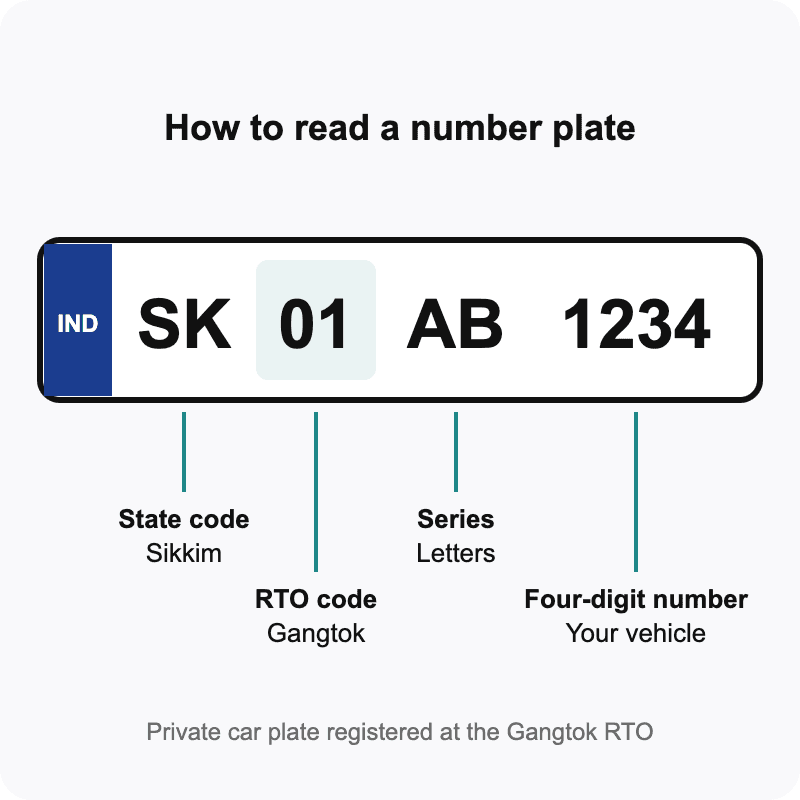
The SK code shows the office where the vehicle was registered, not where the owner lives today. The code stays the same when the owner moves within Sikkim, for example from Namchi to Gangtok. It would change only through a re-registration outside Sikkim or a change to the registration details.
Good to know: Sikkim is a small state, so most vehicles you see carry SK-01. The other five codes belong to district offices, which register far fewer vehicles.
Rule 50 of the Central Motor Vehicles Rules, 1989 requires a High Security Registration Plate (HSRP) on every SK vehicle, so that plates cannot be copied or swapped. To put this into force, the Ministry of Road Transport and Highways (MoRTH) issued G.S.R. 1162(E) on 4 December 2018 and then S.O. 6052 on 6 December 2018. Since 1 April 2019, the manufacturer and dealer fit the plate before a new vehicle is handed over.
To show the plate is genuine, it carries a chromium-based hologram
To link the plate to one vehicle, a unique identification number is laser-etched on it
Non-removable, non-reusable snap locks hold it, so the plate cannot be used again
To show the fuel, a colour-coded sticker goes on the windscreen: Light blue for petrol or compressed natural gas (CNG), orange for diesel
Vehicles registered before 1 April 2019 left the dealer without this plate, so they need a High Security Registration Plate (HSRP) fitted by the dates Sikkim sets. The Sikkim transport department website names the HSRP booking portal. Book the installation there and check the date that applies to your SK vehicle.
Good to know: Fitting an HSRP changes only the plate, so an SK-02 car from Gyalshing keeps its SK-02 number.
Each code with its office and the district it serves
Sikkim has only six offices, so the SK code list is short. The table shows the current district names next to the older ones, which changed in 2021 and 2022.
You may come across lists with codes past SK-06. Check any such code with the Motor Vehicles Department before you rely on it.
SK-01 in Gangtok is the main transport office in the state, located at the SNT Complex. It handles registration, licensing and tax for the capital district. Most vehicles on Sikkim roads carry its code.
Each of the other five offices looks after its own district. Gyalshing covers the west and Mangan the north, while Jorethang, Namchi and Soreng serve the south and south west.
WB codes and offices
Every state and territory
Sikkim renamed its four districts and created two new ones in 2021 and 2022. The RTO codes stayed the same. This means older code lists use district names that no longer appear on a map.
Keep in mind: Your policy follows the address on your Registration Certificate, so keep that address up to date. When a district gets a new name, existing plate numbers and insurance policies stay exactly as they are.
Nearly all roads into Sikkim pass through West Bengal, so WB plates are common here, especially near Siliguri and the Rangpo border. Their codes and offices are covered in the guides below.
WB codes and offices
AS codes and offices
Every state and territory
IRDAI licensed insurer
Cashless partner garages
Dedicated Claims Specialist
Paid once on the invoice cost, with a flat fee on transfer
Sikkim collects road tax once, when a new vehicle is registered, and works it out on the invoice cost. Under a Transport Department memo of 27 March 2025, the rate rises in slabs from about 1% for a vehicle costing up to ₹2 lakhs to 6% for one costing more than ₹50 lakhs. Commercial vehicles pay between 1% and 3%.
For example: A new vehicle with an invoice cost of ₹2 lakhs falls in the lowest slab, so at about 1% its one-time tax comes to roughly ₹2,000. A 1,197cc hatchback that is already registered and changes owner in Sikkim pays the flat fee of ₹4,000, whatever its price.
A private electric or hybrid car pays a reduced one-time tax of 1% of its invoice cost, and commercial electric and hybrid vehicles are exempt
A car bought from a dealer in another state is reported to attract a surcharge of about 50% on the tax. Check the amount on Vahan, which gives the final amount at payment
Taxis and other commercial vehicles have their own lower slabs, from 1% to 3% of the invoice cost
Between the 1% and 6% end points the rate climbs in steps with the price, and Vahan shows the step your car falls in
The tax is paid at the RTO counter when the vehicle is registered, or online under vehicle tax on Parivahan Sewa. Confirm the slab for your invoice cost on Vahan before you pay.
RTO fees are fixed nationally by Rule 81 of the Central Motor Vehicles Rules, 1989, so Sikkim charges the same amounts as other states, from Gangtok to Soreng. Registering a new car costs ₹600, which covers the Registration Certificate (RC), and a motorcycle costs ₹300.
The table shows only the RTO’s own fees, so it leaves out the road tax, the High Security Registration Plate (HSRP) and any service charge that Sikkim adds.
Worth knowing: Renew a private car’s RC on time to avoid the ₹500 charged for every month of delay. It runs for 15 years first, then 5 years at a time.
In Sikkim, the dealer usually files the registration of a new private car on the Vahan portal. You pay the registration fee and any tax due at registration, and the Registration Certificate (RC) is issued after the RTO approves the application.
Registration cannot go ahead without a valid Third-Party policy. Most owners opt for comprehensive cover
The dealer usually files Form 20 with your address proof, the sale certificate and the roadworthiness certificate
Road tax and the registration fee depend on your car and the type of transaction
Once the office approves the application, it assigns an SK number and a High Security Registration Plate is fitted
The Registration Certificate (RC) follows once the office gives its approval
Some vehicles and transactions still need a document check, an inspection or a visit to the RTO. The steps above show the usual path, not a fixed rule.
Note: The dealer only needs a valid policy to register the car, so you are free to buy car insurance yourself before delivery day. Comparing your options first is worth the time.
A used car sale in Sikkim needs two forms: Form 29 from the seller and Form 30 signed by seller and buyer. The SK office named on the RC, such as SK-01 in Gangtok, then puts the car in the buyer’s name for a ₹300 fee.
The seller files Form 29 to tell the RTO the car has been sold
Seller and buyer sign Form 30 to move the RC into the buyer’s name
Add the RC, insurance, a Pollution Under Control (PUC) certificate and address proof for the office’s checks
Apply on Vahan or at the SK office on the RC, and pay the ₹300 car fee
The buyer has 14 days to move the policy, so the cover follows the new owner
After the last instalment, ask the lender for a No Objection Certificate (NOC) and Form 35, as the loan stays on the RC until it is removed. With both, apply on Vahan, and the RTO issues an updated RC with no loan on it. Form 34 does the opposite: It records a loan on the RC when the car is first financed.
Online RTO work in Sikkim goes through the national Parivahan services. Anything about registration, the RC, tax or ownership is done on the Vahan portal, and licence work is done on the Sarathi portal. mParivahan and the e-challan service show vehicle details and challans.
What is fully online depends on the transaction and on the RTO.
On Sarathi, apply for a learner’s licence, pay the fee and pick a test date
Pick a slot for your driving test, which could be held on an automated driving test track
Road tax and RTO fees for your vehicle can be paid on Vahan
Pay or check e-challans issued to SK vehicles through the e-challan portal on Parivahan Sewa
Look up the office, insurance and Pollution Under Control (PUC) status of any SK vehicle through Parivahan Sewa or the mParivahan app
To replace an RC that is lost, stolen or damaged, apply with Form 26 on Vahan or at the SK office that issued it, and a duplicate RC is issued. To confirm what the record shows, look up the number on Parivahan Sewa or mParivahan, or check your RC status with Kiwi Insurance.
Licences run on a national system, so Sarathi handles the learner’s licence, the driving test booking, licence renewal and the International Driving Permit. The driving test itself takes place in person at your SK office.
Traffic fines in Sikkim start from the national amounts set by the Motor Vehicles (Amendment) Act, 2019, shown below. The state may also compound some offences at its own amounts, so check the challan for the amount you actually pay.
To check or pay a challan on an SK number, use the Parivahan e-challan portal, echallan.parivahan.gov.in, or mParivahan, which saves a trip to the office.
Worth knowing: A valid policy keeps you clear of the fine for driving uninsured, which is ₹2,000 the first time and ₹4,000 after that. The car insurance section shows how the policy ties into the RTO record.
The Motor Vehicles Act, 1988, requires a new registration mark for any car kept in another state or union territory for more than 12 months. Cars that stay in Sikkim for that long are registered here. You then pay the tax due in Sikkim and can ask your old state to refund any unused tax.
Use Form 28 to request the No Objection Certificate (NOC) from your old RTO
Give the Sikkim RTO your No Objection Certificate (NOC), RC, insurance and Pollution Under Control (PUC) certificate
Re-registration in Sikkim costs a flat one-time fee of ₹3,500 to ₹5,000, set by engine size
After the office gives you an SK number, fit the new number plate
Have your policy updated with the new number and address
The exact process and documents can differ by vehicle, state and RTO. Check the current steps with the RTO or on the Parivahan Sewa website. If you are leaving Sikkim, get the No Objection Certificate (NOC) from your RTO first. Then register the car in the new state and pay the tax there, which is usually a one-time amount.
With a Bharat series (BH) number, the plate carries no state code, and the same number is valid all over India. An owner posted to another state keeps it, with no No Objection Certificate (NOC) or new registration. An SK number, by contrast, has to be changed after 12 months in another state. The series was introduced by G.S.R. 594(E) of 26 August 2021, in force from 15 September 2021, and G.S.R. 879(E) of 14 December 2022 extended Bharat series (BH) registration to ownership transfers and to converting existing registrations.
The scheme is meant for people posted between states, so eligibility depends on the employer. Government staff at Central or state level are covered, as are defence personnel and public sector employees. For a private sector employee, the employer must have offices in at least 4 states or union territories.
Confirm that your employer qualifies before the car is booked
A private sector employee submits Form 60, a certificate from the employer
Pay BH tax for 2 years at a time, using the rates listed below
The number is issued in the BH format described after these steps
Leaving Sikkim needs no No Objection Certificate (NOC), re-registration or tax refund, as the number is national
The BH number: The format is YY BH #### XX, where YY is the year of first registration, the four digits are allotted at random, and XX represents the alphabetic series, which can be a single letter or two letters. It is black on a white plate, like any other private car.
How it compares: An SK registration settles the tax in a single payment of roughly 1% to 6% of the invoice cost, whereas BH tax takes 8% to 12% of the car’s price every 2 years, so the BH route usually costs more here.
Each main form, its purpose and an official download link


When a used car changes hands, Form 29 and Form 30 are signed by both seller and buyer. Once the new RC is issued in the buyer’s name, the buyer has 14 days to move the insurance.
Note: Hand your forms in at the RTO that matches the code on your RC, such as SK-01 for Gangtok or SK-02 for Gyalshing. Some offices also ask for address proof or a Pollution Under Control (PUC) certificate. Before you go, look at the document list on the Parivahan Sewa website. For anything not covered here, the Parivahan Sewa website keeps every RTO form in one place.
Insurers price the Own Damage part of the premium by the zone of the RTO that registered the car. Gangtok and every other SK office are in Zone B, since none of the eight Zone A cities is in Sikkim. Third-Party cover has one national price. Apart from the zone, the same national rules apply as in any other state.

Every SK office is in Zone B for Own Damage insurance, which keeps the premium below what owners pay in Zone A cities like Delhi

The Third-Party premium is notified nationally, so it is the same in Sikkim as in the rest of India

First transfer the RC at your RTO. You then have 14 days under the Motor Vehicles Act to apply to the insurer for the policy transfer

The code stays the same, so only the address needs updating. Change it on your RC first, then on your policy
No car can be registered without insurance, so a new car is insured first. The policy moves to the buyer within 14 days of an ownership transfer, as cover has to follow the owner. After any move or re-registration, inform your insurer, since the RC and the policy must show the same number.
Worth knowing: Try to transfer both the RC and the policy within the same two weeks. That way the car has full cover, with no break after it changes hands.
Any vehicle in India needs Third-Party insurance before it can be registered or driven. Proof of it is checked at the RTO along with your other papers After the RTO paperwork, make sure the vehicle is insured in your name. The car and bike plans from Kiwi Insurance are listed below.
Explore plans
Explore plans
Sikkim has six RTO offices, with the codes SK-01 to SK-06. They are at Gangtok, Gyalshing, Mangan, Jorethang, Namchi and Soreng, and Gangtok is the main one.
Car insurance built around the day you need to make a claim, with benefits you only get with Kiwi Insurance

Once you register a claim, one specialist dedicated to your claim works with the surveyor and garage and keeps you updated

Builds your No Claim Bonus (NCB) up to a 90% discount and goes down only one slab after a claim, not to zero

Repair your car at a cashless partner garage and the insurer pays the garage directly, so you pay nothing out of your pocket

An optional cover for your usual garage. The claim settlement amount reaches your account before you pay the garage

An optional cover that lets you keep a minor dent on record and repair it together with a bigger claim later

An optional cover that pays cash into your account the day your car is booked in for repair
Benefits apply as per the policy wording and the covers you choose. They are Kiwi Insurance product features, not RTO rules.
Kiwi Insurance Super NCB
Kiwi Flexi Repair
Kiwi InstaCash


Written by
Content Writer
Afsal writes Kiwi’s guides and blog posts and reviews each one for accuracy, clarity and compliance with current rules before publication.